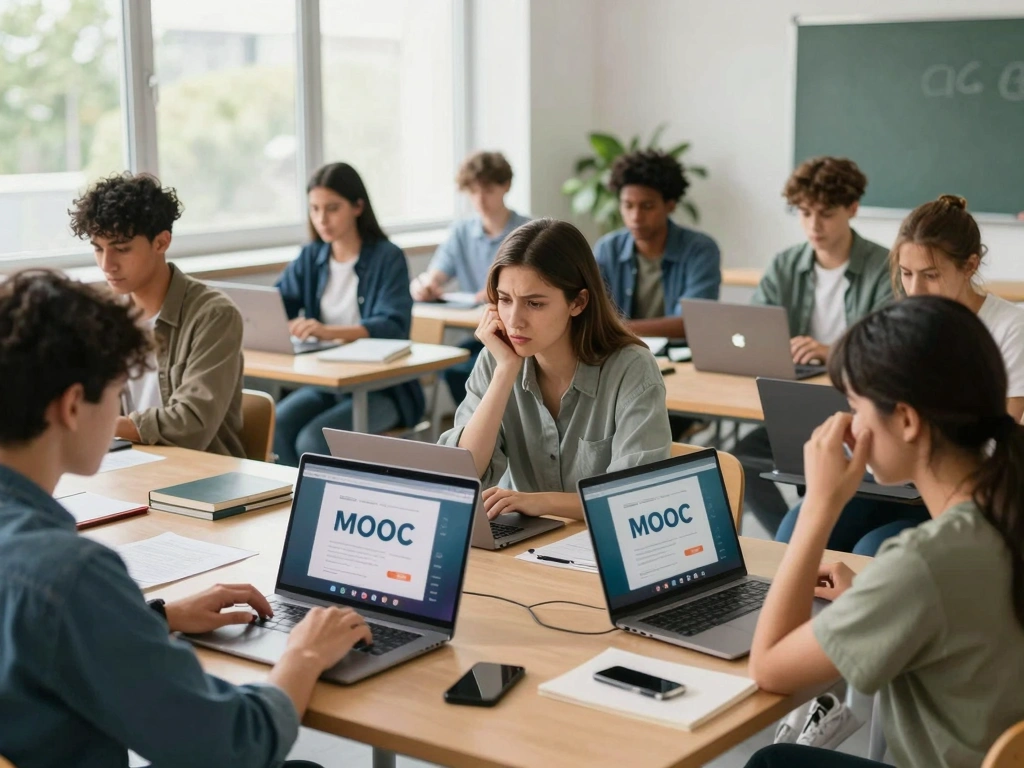
Historical Context of MOOCs and Completion Rates

The Evolution of MOOCs
Massive Open Online Courses (MOOCs) emerged in the early 2010s as a revolutionary approach to education, promising unprecedented access to learning for anyone with an internet connection. Originally developed from open educational resources and community-based learning, the first MOOCs like Stanford's "Introduction to Artificial Intelligence" in 2011 attracted thousands of enrollees. This marked a seismic shift in educational paradigms, with the potential to democratize learning worldwide.
As MOOCs gained traction, platforms such as Coursera, edX, and Udacity proliferated, offering courses from prestigious institutions like Harvard, MIT, and Stanford. The initial excitement was fueled by the belief that MOOCs could not only provide quality education but also significantly lower costs and increase completion rates compared to traditional educational frameworks.
Initial Expectations vs. Reality
In the infancy of MOOCs, expectations were high. Educators and institutions anticipated high completion rates that would mirror traditional classroom settings, with estimates suggesting that 20-30% of learners would complete courses. However, reality painted a different picture. According to research conducted by the MOOC Research Initiative, completion rates typically hovered around 5-10%. This disparity prompted a reevaluation of the factors contributing to learner success in an online environment.
Tracking Completion Rates Over Time
Over the years, various studies have tracked MOOC completion rates, revealing a persistent trend of low engagement. A 2019 report from Class Central indicated that while enrollment numbers had surged, the overall completion rate remained stagnant at around 7%. This raises critical questions about the efficacy of MOOCs as a viable educational model and highlights the need for deeper analysis into the reasons behind these low completion rates.
Factors Influencing Learner Engagement
The Role of Motivation in Online Learning
Motivation is arguably the most significant factor influencing learner engagement in MOOCs. Research indicates that intrinsic motivation—driven by personal interest and the desire to learn—results in higher completion rates than extrinsic motivation, such as obtaining a certificate or fulfilling job requirements. A study by the Online Learning Consortium found that learners who enrolled out of personal interest were 30% more likely to complete their courses than those motivated by external factors.
Furthermore, the self-directed nature of MOOCs can lead to a lack of accountability, making it challenging for learners to stay committed. Without regular interaction with instructors or scheduled class times, learners often find it easy to disengage, leading to increased dropout rates.
Impact of Course Design on Learner Experience
Course design significantly affects learner experience and completion rates. MOOCs that incorporate interactive elements, such as quizzes, discussion forums, and multimedia content, have shown improved engagement. For example, edX's "Introduction to Computer Science" course uses a blend of video lectures and hands-on programming assignments, which keeps learners actively engaged and motivated to complete the course.
Moreover, courses lacking clear structures, deadlines, or engaging content tend to see higher dropout rates. A 2020 study published in the Journal of Online Learning Research emphasized the importance of course design, noting that MOOCs with clear learning pathways and regular feedback mechanisms had completion rates exceeding 15%, compared to those with minimal interaction which languished around 5%.
Peer Interaction and Community Building
Peer interaction plays a crucial role in sustaining learner engagement. Many MOOCs lack robust community-building features that encourage interaction among participants, which can lead to feelings of isolation. A study from the University of Pennsylvania found that learners who engaged in discussion forums or study groups were significantly more likely to finish their courses than those who worked in solitude. This emphasizes the need for platforms to foster a sense of community, which can enhance motivation and accountability.
Some platforms have begun to implement features that facilitate peer interaction, such as peer review systems and collaborative projects. For instance, Coursera has introduced community discussion boards that allow learners to share insights and support each other, resulting in increased completion rates in courses where these features are actively used.
Demographics of MOOC Participants
Understanding the Profile of MOOC Learners
The demographic profile of MOOC participants is diverse, often including a mix of professionals seeking to upskill, college students, and lifelong learners. A report from the Babson Survey Research Group noted that approximately 60% of MOOC participants already hold a college degree, which suggests that many are using MOOCs to supplement their existing knowledge rather than for foundational learning.
This demographic skew towards educated individuals can result in higher expectations for course quality and engagement, leading to frustration when these needs are unmet. Consequently, when the courses do not align with their expectations or learning goals, motivation wanes, contributing to higher dropout rates.
Barriers Faced by Diverse Learner Groups
Different learner groups face unique barriers that contribute to low completion rates. For instance, working professionals may struggle to find time for coursework amidst job responsibilities, while learners from lower socioeconomic backgrounds might lack the necessary resources or support systems. A survey conducted by the Pew Research Center highlighted that about 25% of MOOC learners cited time constraints as a significant barrier, which directly impacts their ability to complete courses.
Additionally, many international learners encounter language barriers, which can hinder their understanding of course materials and limit their ability to engage in discussions with peers. This lack of support can make it difficult for diverse learner groups to navigate the MOOC landscape, emphasizing the need for more tailored supports and resources.
Retention Rates Among Different Age Groups
Retention rates in MOOCs also vary significantly across age groups. Younger learners, typically aged 18-24, often demonstrate higher completion rates compared to older adults, primarily due to their familiarity with technology and social media. However, older learners may bring valuable life experiences and motivations that enhance their engagement if adequately supported.
A study conducted by Online Learning Consortium found that learners aged 18-24 had an average completion rate of 12%, while those aged 45 and above completed at a rate of just 4%. These statistics underscore the necessity for platforms to adapt their offerings to better engage older learners, perhaps through mentorship opportunities or tailored content that relates to their experiences.
Technological and Accessibility Issues
Internet Connectivity and Its Impact on Completion
Despite the global reach of MOOCs, inconsistent internet connectivity remains a significant barrier to completion. In many regions, particularly in developing countries, learners face challenges accessing stable internet connections, which can hinder their ability to engage with course materials effectively. A report from the International Telecommunication Union revealed that only 45% of individuals in developing nations have access to the internet, limiting their ability to participate in online learning.
This issue not only affects access but also impacts the overall learning experience. Learners who experience frequent disruptions may become frustrated and disengaged, leading to an increased likelihood of dropping out. Addressing these connectivity issues is crucial for improving MOOC completion rates globally.
User-Friendly Platforms and Navigation Challenges
Another technological barrier to completion rates is the user-friendliness of MOOC platforms. Many learners report difficulties navigating complex course interfaces, which can deter them from fully engaging with the material. A 2021 study by the Journal of Educational Technology found that platforms with intuitive designs and straightforward navigation had completion rates 20% higher than those with more complicated interfaces.
To mitigate these challenges, MOOC providers must prioritize user experience in their platform design, ensuring that learners can easily access course content, track their progress, and communicate with peers and instructors without technological hurdles.
Accessibility for Students with Disabilities
Accessibility remains a critical concern in the MOOC landscape, particularly for learners with disabilities. Many MOOCs do not adhere to universal design principles, which can limit accessibility for individuals with visual, auditory, or cognitive impairments. A study by the National Center on Disability and Access to Education found that 30% of learners with disabilities reported difficulties accessing course materials due to a lack of accommodations, leading to lower completion rates.
To enhance inclusivity, MOOCs must implement accessibility features, such as captioning for video content, screen reader compatibility, and alternative text for images. By fostering a more inclusive learning environment, MOOC providers can improve completion rates among diverse learner populations.
Strategies for Improving Completion Rates
Innovative Course Structures and Formats
Adopting innovative course structures and formats is essential for enhancing learner engagement and improving completion rates. For example, modular courses that allow learners to progress at their own pace can accommodate varying schedules and learning styles, as demonstrated by platforms like FutureLearn, which offers micro-credentials in bite-sized learning segments.
Additionally, incorporating gamification elements—such as badges, leaderboards, and interactive challenges—can motivate learners to engage more actively with course materials. Research from the University of California, Irvine, found that courses featuring gamified elements increased completion rates by 25%, demonstrating the effectiveness of this approach in cultivating learner motivation.
Enhancing Support Systems for Learners
Providing robust support systems for learners is crucial for improving completion rates. Personalized support through mentorship programs, tutoring, and dedicated learning coaches can significantly enhance learner retention. For instance, platforms like Coursera have begun to implement mentorship opportunities in select courses, resulting in a 15% increase in completion rates among participating learners.
Additionally, creating comprehensive onboarding processes that guide learners through course expectations and available resources can alleviate confusion and enhance engagement. A study by the Online Learning Consortium found that courses with structured onboarding processes had completion rates 10% higher than those without.
Leveraging Data Analytics for Personalized Learning
Data analytics can play a pivotal role in improving MOOC completion rates by enabling personalized learning experiences. By tracking learner progress and engagement patterns, MOOC providers can identify at-risk students and intervene before they drop out. For instance, platforms like edX utilize predictive analytics to assess learner engagement and provide tailored recommendations for additional resources or support.
Furthermore, personalized learning paths that adapt to individual learner needs can enhance engagement and retention. By leveraging technology to create a more customized learning experience, MOOCs can foster a sense of ownership and accountability among learners, ultimately leading to higher completion rates.